
Season 1 · Episode 5 · 2 November 2026
Parma 1993: Bought? How a Cheese Town Won a European Trophy at Wembley
A small town in Italy, known for ham and cheese, wins a European trophy at Wembley with a team it grew itself. The question is who paid for it.
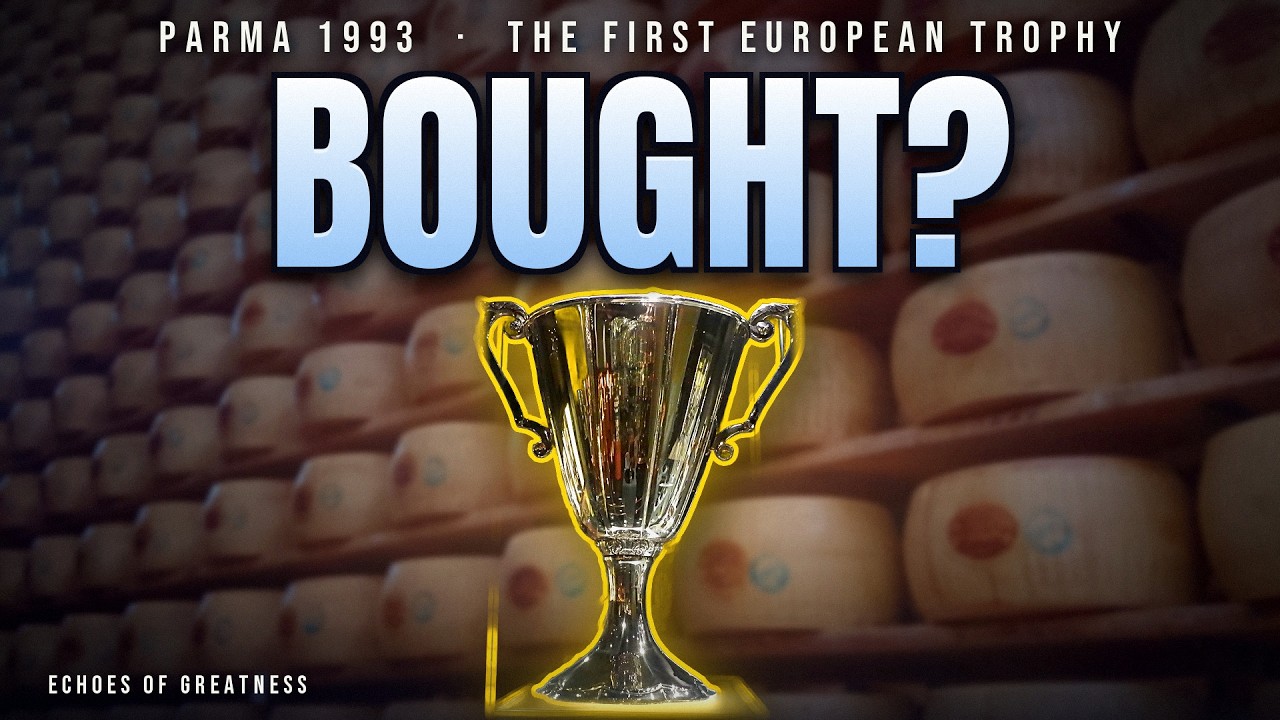
Parma's rise from Serie B to the 1993 Cup Winners' Cup final: Nevio Scala, the Parmalat money of Calisto Tanzi, Faustino Asprilla, the turn of the 1992/93 season and the night at Wembley, and the bill that came years later when Parmalat collapsed.
If a club's best years were paid for by a company that later collapsed, who do those years belong to?
In this story: 16 chapters · about 42 minutes to read
1The airport room
Monday, 10 May 1993. An airport in northern Italy, early in the morning. A football team is gathering for a flight to London. Before anyone has checked in, the owner of the club asks for a private room. Two days from now this club will win the first European trophy in its history. The question is how it got there: was this team grown, or was it bought?
The story goes that he keeps it short. Thank you for everything you have done this season. Thank you for everything you are going to do on Wednesday. Then the players file out towards the gate.
And then, late, a man limps in. Faustino Asprilla is 23 years old, a Colombian forward, and the most talked-about signing the club has ever made. He has missed the meeting. He is walking like someone who has hurt a leg. On the plane, the coach, Nevio Scala, will tell him, by Scala's own account, that he is not fit to play.
But at Wembley, the man who was meant to be the star of this season will not kick a ball.
The ninth minute. A corner from Marco Osio. The Royal Antwerp goalkeeper fumbles it, and the Parma captain, a defender called Lorenzo Minotti, volleys it in! Within two minutes Antwerp have scored too. But by the end it is three goals to one, and a city of about 170,000 people, famous for ham and cheese, has beaten a Belgian side in their first European final.
So how did Parma get there? That is the easy part to tell. The harder part is the question hiding behind it.
Almost everything about this dream was paid for by one company. The wages, the foreign players, and, if the stories are true, a helicopter and a private plane. And that company sold milk. Ten and a half years after this night it would collapse, in what was described as the largest bankruptcy in the history of Europe.
So here is what we are going to find out. How much of Parma's dream was grown, and how much of it was bought?
And the man who limped into that airport late? By his own account, when his coach wanted him to run round the walls of the city, he said no. I am not Forrest Gump, he told him.
To answer the big question, we have to start with the town, and with a word that Italians use about football that happens in towns like it.
2The town and the word
Parma is a city in the north of Italy, between Milan and Bologna. At the census of 1991 it had 170,000, 520 people. It has a medieval cathedral, a pink marble baptistery, an opera house, and a composer, Giuseppe Verdi, who was born in the province.
But mostly Parma is known for what it puts on a plate. Parmigiano Reggiano, the cheese. Prosciutto di Parma, the ham. The kind of food that people who have never been to Italy still order by name.
It was not known for football. Parma had spent most of its history in the second and third divisions. Before the 1960s were out, the club had dropped as low as the fourth tier, and, the story goes, gone bankrupt and been put back together. Until 1990, it had never played a single season in Serie A.
Italians have a phrase for football like that. Il calcio di provincia. Provincial football. It is meant a little unkindly. It means the game as it is played in towns that do not count, far from the big cities and the big trophies, in the middle of the table, where nobody is looking.
Now, I want you to hold one picture from this episode, because we will keep coming back to it. It comes from Carlo Ancelotti, who became one of the most successful coaches in the history of the game. Ancelotti is a farmer's son from the same part of Italy. His father worked a small farm with dairy cows. And the picture, as I am paraphrasing it from what he has said over the years, is of a family that got up at four in the morning to milk the cows and work the land.
And he has said, in words I am paraphrasing, that growing up on a farm taught him a great deal about coaching. The same calm. The same patience. The same planning. You sow in one season, the idea goes, and you harvest a year or two later. A wheel of the local cheese cannot be hurried either. It needs at least a year to age.
That is the romantic idea of Parma. A club grown in the fields around the city, slowly, by people who knew what they were doing, out of what the soil gave them. Home-grown. Organic. Provincial, and proud of it.
It is a beautiful picture. And there is something true in it. But a patient story still needs someone to pay the rent while the crop comes in. And in Parma, in the last years of the 1980s, the rent was being paid by a man who had, by most accounts, left university at 22 and gone into the milk business, and who was by then nearly 50.
3The milk man
The club's story really begins in 1976, when a local builder called Ernesto Ceresini took it over. He was 36. Parma were in the third division. Ceresini had lost his wife young, and, by the account that is usually told, he poured himself first into his work, and then into the club.
He gave it everything, probably more than was good for him, and the club kept getting better.
The first thing he did right was to hire ambitious young coaches. One was a man who had never played professionally, called Arrigo Sacchi. Sacchi took over in 1985 and won the third-division title in his first season, taking Parma up into the second. He knocked Silvio Berlusconi's new Milan out of the Italian cup, winning 1-0 at San Siro and holding them to 0-0 at home. He came within three points of promotion to Serie A. And then Berlusconi hired him away to Milan, where he would build one of the great teams in the history of the sport, on ideas about pressing that you will hear a lot more of in a few minutes.
Parma had been Sacchi's stepping stone. Replacing him was not easy. First came a coach called Zdenek Zeman, who lasted seven matches. Then an ordinary coach, who produced ordinary results. Eleventh in the second division. Ninth the year after.
That was not the Parma way, said the people who paid for it. Which brings us to the people who paid for it.
By most accounts, Calisto Tanzi was 22 when he started Parmalat in 1961, having left university. Sources differ on what he started from, a family milk company or a family ham business. Whichever it was, he went into dairy with a new idea: milk that would last. Long-life milk, in a carton, that did not have to be kept in a fridge. From there came cream, and fruit juice, and tomato sauce, and, in time, biscuits and bread. Parmalat grew, and grew, and grew.
Tanzi had also worked out something else early. Sport sells. In the late 1970s, Parmalat put its name on a Formula One team, Brabham, from 1978 to 1984, with drivers like Niki Lauda and Nelson Piquet. It worked. And when Tanzi turned to football, he did not go small. By the summer of 1987 Parmalat was the shirt sponsor and a part-owner of the club in his home town. Sources differ on the day: one says June, another 1 July.
The builder was the face of the club. The milk man was the money.
Now they needed a coach. And for that, they went looking for a hunter's son.
4The hunter's son
In the summer of 1989, Parma's new coach was Nevio Scala, a man in his early forties from a village near Padua. He did not come from Parma. But he came from a farming family, and from, by his own account, the right kind of place. I was born with a gun on my shoulder and a ball at my feet, he is quoted as saying.
He had been a midfielder. In the late 1960s he was at Milan, in the squads that won the Italian league, the Cup Winners' Cup and the European Cup, though he did not play in the European Cup final. He knew what winning looked like from the inside.
Then he became a coach, and almost did something no one expected. He took a small club called Reggina up from the third division to the second, and missed out on a place in Serie A only in a penalty shoot-out in a play-off, against Cremonese. After that, other clubs came looking. Cesena, in the top division, made him an offer.
But, the story goes, he had already given his word to Tanzi and to Ceresini. And Scala is a hunter's son. A hunter's son does not go back on his word. So he came to Parma.
He came with a system, and the system was a fusion. A sweeper sat behind a back line of three, in the old Italian way, with two wing-backs running up and down the sides, five at the back when they defended. But in front of that, the team pressed, in the new way, the way Sacchi had taught the country. The whole side moved up and down the pitch as a block, marking space. And only when the opposition had got all the way back to Parma's own penalty area did it switch, and every player picked up a man.
That was the football. The philosophy was even stranger for the time. Scala did not like stars. Star culture, he used to say, is a plague. He did not want a team of five great players and five who carried their water. He wanted 11 men with the same status, the same rights, the same duties, and almost the same pay. In this Parma, there were hardly any wage differences, and he meant to keep it that way.
That summer he gathered the squad in Folgaria, an alpine village, for the hard pre-season work that every Italian team put itself through. And he looked at what he had. A group of young players with no names at all. Lorenzo Minotti, 22, a centre-back who, the story goes, had arrived two years earlier straight from his military service, driving his father's little Alfa Romeo. Luigi Apolloni, 22. Marco Osio, 23, a midfielder with long hair and a shirt that hung out over his shorts. The supporters called him Il Sindaco. The Mayor.
And the local boy, Alessandro Melli. His father had played for Parma in the 1960s. As a child Melli had stood on the terraces. He made his debut at 16, under Sacchi, and while still a teenager he scored the goal that took Parma up from the third division. He was already the hero.
Scala asked Tanzi for none of the expensive signings that owners dream about. The one big arrival that summer was a playmaker, 167 centimetres tall, called Daniele Zoratto. The average age of the team was 23.
Their first real test came in the first round of the Italian cup, against Milan, the reigning champions of Europe. Parma drew 0-0, and lost the shoot-out, seven to six. By the story, Baresi, Van Basten and Maldini were among the men who stepped up. They had lost, but they had not been beaten.
If you can hold that Milan to nothing, thought Scala's players, you can hold anyone. And so, in the second division, they set out to prove it.
5Promotion
The 1989/90 season in Serie B began the way Scala wanted. Parma kept a clean sheet in each of their first three games, and by the end of the season they would keep 16. The defence was a fortress. The attack was another matter.
At first the team scored little, and Alessandro Melli, who was used to running at everything and shooting at everything, suddenly had less to chew on than ever. By Melli's own telling, there was little warmth between him and the coach that winter. It was the first real crack in the project. Years later, Melli would call Scala a second father.
So, in the winter, Parma had to decide what they believed in. The offers were there. Melli could have been sold. So could Minotti and Apolloni, the two young defenders. And Ernesto Ceresini, the old builder, said no to all of it. He told Scala to value Melli, and he kept everyone.
The sporting director was a veteran named Giambattista Pastorello, who had come from Padova that same year. He says that was the winter the modern Parma was born. Because the club did not sell its young. It stood still, and waited, and let them grow.
And then, on 4 February 1990, Ernesto Ceresini died, suddenly. The whole city mourned him.
The team did not know what to do with its grief. For seven matches, Parma did not score a goal. They won one point out of 14, and Melli, the player closest to the president, was sent off in the first match after the funeral. The season, which had looked fine at Christmas, was draining away. By April they should have been finished.
But the second division of that time had two things in its favour. It was an even league, and four teams went up. It was hard to lose touch with the dream completely. And when Parma finally pulled themselves together, when they decided to play for Ceresini and for nothing else, the picture turned over. Six wins in seven games, with one draw in the middle.
Which brings us to the last day of the season, 27 May 1990. Parma against Reggiana, the club from the next town down the road. Serie A for the first time in their history was in their own hands.
Marco Osio scored. Alessandro Melli scored. 2-0! The same two men who would be on the scoresheet again and again, for years. Parma finished fourth in Serie B with 46 points, behind Torino, Pisa and Cagliari, who had 53, 51 and 47. Four teams went up. Parma were one of them.
And since this is Parma, they celebrated to the music of the local hero. The Triumphal March from Verdi's opera Aida. Which is a song about Egyptians beating Ethiopians, thousands of years ago. It is not clear that anyone in the stadium knew that. It sounded triumphant, and that was enough.
Ceresini was not there to hear it. He had given the club 14 years, and he died less than four months before that day.
But that same spring, a larger story was moving through the same town. And its centre was not a football club.
6The money arrives
Parmalat was getting bigger. Around the time Parma went up, the company was being listed on the stock market, and in the years that followed its turnover is said to have multiplied several times over. At its height, by the usual figures, it employed more than 30,000 people in some 30 countries, and it counted among the biggest industrial groups in Italy.
The football club was about to be pulled along. Parma had been in a kind of ownership limbo since Ceresini's death. Now Calisto Tanzi stepped in. By one account, Parmalat bought a small share in July 1990, and within weeks held nearly all of it. Sources disagree on exactly when the family took full control: 1990, or 1991.
The first Serie A summer was an odd one. A player called Fausto Pizzi had scored 12 goals on loan from Inter, but Inter took him back. The goalkeeper was sold to Lecce. Scala kept his sporting director, Pastorello, and was given a new permission. For the first time, a promoted Parma could sign foreign players. Three of them.
Not one of them could be a mistake. They had to be stars who could lift the team. But they also had to fit Scala's idea of a flat dressing room, where nobody earned much more than anyone else.
The first signing surprised Italy. Parma bought a Brazilian goalkeeper. At the time, Italian football trusted its own goalkeepers almost without exception, and a foreign one was a rare thing indeed. This was partly the sponsor's doing. Brazil, the story goes, was Parmalat's most important market, and look what sponsoring the Formula One driver Nelson Piquet had done for the brand. So a Brazilian would come. Names were thrown about. Scala said no to every one of them. He did not want a showman who would talk about the carnival all season. If it had to be a Brazilian, it would be a civilised one.
They settled on Cláudio Taffarel. 24 years old, from Internacional, for a reported fee of about 1.7 million dollars. And Scala liked what he heard. Taffarel was deeply religious. The word in Parma was that he slept with a Bible on his bedside table.
The story goes that he once agreed a move to Empoli, but his car broke down on the way to sign. He took it as a sign from above, and stayed. In 1993 he did leave, for the neighbours, Reggiana.
The second foreigner was a Belgian defender, Georges Grun, 28, who had played at two World Cups. A solid man for a back line full of youngsters. And the third was Tomas Brolin, 20 years old, a quick forward with a good touch who had just had a very good World Cup. The reported fee for him was somewhere between three and three and a half billion lire.
Together, all three cost around 7 billion lire, by the usual reckoning. The story in Parma is that Scala and Pastorello had a budget of 18 billion. They could have spent more than twice as much. They did not. They kept the peace in the dressing room.
There was also the matter of where to train. The answer was that Parma did not have a training ground. The players changed at the stadium, climbed into a minibus, and drove to whichever municipal pitch was free that morning. Often it was the Citadel, a 16th-century fortress with a park around it. Training in a park, then, at the highest level of Italian football.
The Tardini, the home ground, had opened in 1923, and in those years it was an old stadium being rebuilt around its supporters, one stand at a time. The story in Parma is that season tickets went from about two and a half 1,000 in the last season in the second division to more than 13,000. The town had fallen in love before a ball had been kicked.
A promoted club with a Brazilian goalkeeper, a half-rebuilt stadium and a bus for a training ground. Nobody expected much.
7The honour pact
And at first, nobody got much. They lost the home opener to Juventus, 2-1, with Melli scoring the club's first ever goal in Serie A. They lost twice to Fiorentina in the Italian cup. They drew 0-0 at Lazio.
Then came Napoli. The champions of Italy, with Diego Maradona. It was a turbulent time in Naples, and the team was fragile. Parma were not, and Marco Osio headed in the winner, for the club's first win in Serie A.
And after that, the season turned. At the end of September Brolin scored his first league goal, at Bari. At Fiorentina, the team that had wanted him, Parma were 3-0 up at half-time, and Melli scored what the story calls one of the great goals of the year. A cross comes in, he takes it on his chest, and it carries on behind him, over his own head. He spins around, and before it touches the ground he volleys it from 25 metres, in a high arc, over the keeper. The only film of it, it is said, is a strange angle from the back of the stand.
Over the winter Parma lost only a handful of league games. And then, in January, came Milan, the reigning European champions.
Before that game, the story goes, Scala handed his players a small booklet. It contained the poem If, by Rudyard Kipling. The idea of the poem is to keep your balance when the storm is around you. To treat triumph and disaster, in Kipling's words, as two impostors, and meet them just the same. It is a long poem. It was a booklet. The coach, in short, was a man with a sense of occasion.
On 20 January 1991, Milan came to the Tardini and lost. Osio put in a cross, Costacurta missed it, and Melli hit it on the half-volley. By the account usually given, Melli scored twice. Sacchi, who knew the team well, is said to have admitted afterwards that Parma had played better football than his side. One newspaper, reporting the result, noted that the whole Parma squad had cost about 13 and a half billion lire.
Everything seemed possible. The next week was Juventus, away. If they won in Turin, the newspapers said, they would win the league. And then somebody closed the book. Juventus won 5-0, with two late goals from Roberto Baggio. At Napoli, Maradona scored twice. Parma slid down the table and into the middle.
Then fate did something odd. In March, Milan went to Marseille for a European Cup quarter-final. The floodlights failed during the game. When the lights came back, Milan refused to continue, and the European governing body threw them out of European competition for the following season. That freed up an extra place in the UEFA Cup, and suddenly a whole group of middle-of-the-table teams could see Europe.
Parma did not have much petrol left in the tank. A decision was needed. Melli had received offers from nearly every big club in Italy, Milan among them, offering 10 billion lire and a player. Others in the squad were being courted too. So, with two matches left, the players called a meeting of their own.
How do we feel? Have we done what we came to do? Is it time to move on, or have we only just started?
Everyone said what they wanted. And as it turned out, none of the players the big clubs were chasing wanted to leave. It became Parma's version of the honour pact that Sampdoria's stars had made on their way to the title, to stay together and see how far they could go. It was another time, when even small clubs could hold on to their jewels.
On the last day of the season Parma took a point at San Siro, 0-0, in what was Sacchi's final game as Milan's coach before the national team job. And Juventus lost to Genoa. By the end of the afternoon, Parma were sixth with 38 points, in the UEFA Cup. Juventus were out of Europe altogether, for the first time in nearly 30 years.
The little club had taken the place of the big one. And the group that had said no to everyone else was about to find out what it could win.
8The homespun cup
The summer of 1991 was the quietest of the story. No big name left, so there was no need to buy one. A defender, Enzo Gambaro, went to Milan for a reported 6 billion lire. Two players came in whom hardly anyone noticed. Antonio Benarrivo came from Padova, and Alberto Di Chiara came from Fiorentina.
They were wing-backs, the two most demanding positions in Scala's system. Di Chiara had been a winger until Fiorentina's Brazilian coach turned him into a left-back. Both could run all day. Between them they would turn out to be the engine of the team. A striker, Massimo Agostini, came from Milan. And that was about it. The first team squad was 17 players, and the club said it was happy.
The first taste of Europe came that autumn. In the UEFA Cup, Parma met CSKA Sofia. 0-0 away. At home, they were far better. Melli missed a penalty, hit the bar twice, and the team struck the post. Agostini finally scored, about 20 minutes from the end, and it looked done. Then, with a minute to go, a set piece for the Bulgarians, a second ball, 1-1. Parma were out on away goals.
It was a brutal way to leave. But the crowd did not whistle. They stood and applauded the players for a long time. That says something about what the town thought of its team.
With Europe over, the cup became the point of the season. The Italian cup of that time was played over two legs in every round. Parma beat Palermo, then Fiorentina, then Genoa. In the semi-final they met Sampdoria, the champions of Italy, with Roberto Mancini in the side. Brolin's goal won the first leg, 1-0.
In the second leg, the match went to extra time. 2-2. Melli scored twice. And Parma were in a cup final, the first in their history.
Two years earlier, it had been the first promotion. A year earlier, the first place in Europe. Now, the first final.
The opponent was Juventus. The first leg was in Turin, on 7 May 1992. A penalty from Roberto Baggio decided it. Juventus one, Parma nil. That, everyone said, was that. The story goes that Juventus's coach, Giovanni Trapattoni, sent his team to the Tardini for the second leg only to hold on, to lock the game.
It was a dangerous plan. Because this was not a team that could be locked. Parma had structure and discipline, but they could also open a match up and drive it when they had to.
The goals came from the two men who had always scored the goals. Melli, on the stroke of half-time. Osio, in the 61st minute. 2-0, on 14 May! 2-1 on aggregate. Parma had won the Italian cup, the first trophy in their history, while finishing seventh in the league.
Look at the scorers of the great days. Melli and Osio had got Parma promoted. Melli had scored their first goal in Serie A, and Osio had headed in their first win. And now the same two men had won them a cup.
There are two small stories from that final that Parma tell. The first is that Alberto Di Chiara's baby was due around the time of the game, and that the owner, Tanzi, lent him a helicopter to fly between the team camp and the hospital. The second is that Antonio Benarrivo, on the pitch, blocked a shot with his face. Neither is in the record books. Both are in the legend.
For many people in the city, that was the proof. A team made in the third and second divisions, topped up with a few extras from outside. It had taken a small provincial club to its first trophy, built, as many in the city saw it, almost entirely from its own labour.
So what next? That was the problem with success. It made the club want more. And the market, that summer, was about to get a great deal louder.
9An aspirin from Medellín
Italian football in the summer of 1992 was swollen with money. The rules now let a club register more foreigners, though only three could play at once. And the big clubs spent as if the dam had broken. Milan paid a world-record fee for Gianluigi Lentini. They also signed the French striker Jean-Pierre Papin. Lazio signed Paul Gascoigne. The best league in the world was getting better by the week.
Into that came little Parma, with their home-grown football from the fields, wondering what they could do about it. And the answer most of the people at the club reached was the obvious one. To grow another step, they would need something new. Two foreign places had opened up. They would fill them.
The fourth was an Argentine called Sergio Berti, from River Plate. He made little noise. The fifth, however, would make plenty.
Faustino Asprilla played in Colombia, for Atlético Nacional, in Medellín. He was also in the Colombian Olympic team, and that is how Parma first found him. In February 1992, the South American qualifying tournament for the Olympics was played in Paraguay. Parma had scouts there, Pastorello says, and so did most Italian clubs. The top scorer of that tournament, a Colombian called Ivan Valenciano, went to Atalanta. But the Parma scouts had seen something else.
Pastorello says the report they sent home was like nothing he had ever read. A player who was explosive from a standing start, and then had a further gear above that. A great finisher. Creative, unpredictable, two-footed. And he did what a careful man does. By his own account he phoned each scout separately, to make sure they had not simply talked each other into it. Each of them said the same.
So the sporting director got on a plane to Medellín. By his own account, he checked into his hotel under a false name and stayed for a week. One morning, he says, he woke up to find the hotel surrounded by around 250 police officers. It turned out to be a coincidence. A major trial was beginning that day, and the police were protecting the witnesses.
Pastorello saw the player play, and concluded that the scouts had been right. Then, through middlemen, he met him. And he gave him, he says, 5,000 dollars in cash, to show that Parma were serious.
There was a queue. Fiorentina were ahead of Parma in it, but they had a problem with their foreigners, and they were hesitating. Pastorello did not hesitate. He needed someone from Atlético Nacional with the power to sell, and he needed him in Italy, in his own backyard. The club's president, Sergio Naranjo, flew to Parma in April 1992.
By ten o'clock that night, Pastorello says, they had a deal. He got into a car, drove to Milan, and got the paperwork registered at the league office before midnight. The next day, Asprilla was flown over. A medical, a night in a hotel, and out again, before anyone had worked out who had been visiting.
About the fee, the sources do not agree. Colombian newspapers at the time reported 5 million dollars for Atlético Nacional, and seven and a half million in all once the middlemen were paid. English-language accounts put it at close to 11 million. What nobody doubts is what it was called when it was done. Asked by a journalist what deal he had just made, Pastorello is said to have answered that Parma had taken an aspirin, and hoped it would help.
That was all they did. They tried, Pastorello says, for some of the best young Italians, and failed. A reserve centre-back came in, and Fausto Pizzi, who had scored 12 goals in the promotion year, returned from Inter. And so the plan for the scudetto, the league title, was this. The same 11 as before. Plus Asprilla.
But a plan is only a plan until the player turns up.
10The wrecking ball
It went badly right from the start. They lost the Italian Super Cup to Milan, 2-1, on 30 August. A week later they lost the first league game, at Atalanta, 2-1. The story goes that the goalkeeper, Taffarel, had forgotten about a rule change that summer. Goalkeepers could no longer pick up a back-pass with their hands. He realised halfway through the action, tried to control it with his chest, and was forced to bring somebody down. Penalty, red card, defeat. It was one of the things that pushed him towards the bench.
But he was not the only one. In the first eight league games Parma lost five. Asprilla scored once. On 4 October they lost 5-2 at Lazio, and for the first time in this story, the supporters protested. Until then, everyone had been in a state of bliss. Now they asked what on earth was going on, and no one had an answer. On 25 October, the team lost 2-0 at home to Milan, and then lost to Foggia. Parma were near the bottom of the table.
Scala is reported to have explained it, partly. He said that what had always been Parma's strength, 11 men defending as one, had started to be taken for granted. People thought it came for free. It does not. The forwards have to press. They had stopped. The team had sinned by believing it could control matches. He said they needed to change the way they attacked.
He also let it be understood, and this is what is usually reported, that it had not exactly been him who wanted the Colombian.
Because here is what was happening away from the training ground. Asprilla was 22, and had arrived in a place where everybody spoke another language, and where the football was a different religion. He turned heads. His phone was the size of a rucksack, and it is said to have weighed six or seven kilograms. He called Colombia all day.
The stories about him that circulated in Parma that autumn are the kind that grow with the telling, so I will say which are his own. Asprilla says that Scala had the squad take long morning walks, and that one morning he was so sleepy, he fell in the lake. He says Scala wanted him to run around the walls of the Citadel as part of the training, and that he refused. I am not Forrest Gump, he told him. For him, he explained, football was always about fun. It was without rules.
The rest is the story of the town. Scala, they say, carried a notepad and wrote out penalties on the spot, like a traffic warden. Asprilla says he once ate one of them at the table, a fine for 3 million lire. And they say that Calisto Tanzi, the owner, quietly made all of his fines go away.
That he once took off his boots during a training run, threw them over a wall, and walked barefoot into the dressing room. That, by his own account, he bought 100 taps that he says were gold, and had them shipped to Colombia, and did the same with sunglasses. That a smart car dealer turned him away, thinking he was a street vendor who had wandered in, and so he bought four Toyota jeeps on the spot, and also a Ferrari for himself. That he ordered seven plates of pasta, and never reached the meat. That he arrived at training on a scooter, when he was not allowed to.
None of that is in a document. All of it is in Parma.
What mattered to Scala was this. His whole system rested on 100 small rules that everyone kept, and now a single man was visibly not keeping them. And the rest of the team? The story goes that something was catching. Alberto Di Chiara, one of the wing-backs, was injured that autumn with a light strain, and expected to be out for a week. At a team dinner, the story goes, Antonio Benarrivo, the other wing-back, a serious professional, pulled his friend's chair away as he sat down. Di Chiara fell flat on the floor, made the injury worse four times over, and was out for the rest of the year.
It is a funny story. It is also the story of a club that had always been famously calm, and was no longer.
By November, Scala had a long line of defeats, a defence that had stopped being stable, and a list of injured players that kept growing. If it was not a crisis, it was a close relative. He had agreed to take a risk, on the grounds that if it failed he could simply bench the man. He had not imagined that one young striker could upend a whole way of working.
The fix, when it came, was not a speech. It was a player coming back from injury.
11The turn
Parma's best hope was the Cup Winners' Cup. They had qualified because they had won the Italian cup. Last year they had stumbled in the first round of Europe. This year, they got past Ujpest from Hungary. Parma won the first leg 1-0 at home on 16 September, with a goal by Asprilla, three minutes after the break. They drew 1-1 in Hungary on 1 October. 2-1 on aggregate.
Next came Boavista, from Portugal. In the first leg at home, on 21 October, Parma played badly, and only drew 0-0. The second leg was on 4 November. One record lists it as played in a town called Torres Novas, and not at Boavista's own ground. I have not been able to find out why, and I am not going to guess.
What happened there was the first sign of a change. Tomas Brolin had been out injured. Now his knee had healed enough for him to play, and Scala, who was not heartbroken at the thought, put Asprilla on the bench and Brolin in the team. And Parma looked like Parma again. They won, 2-0, clearly, and went directly from Portugal to a retreat that Scala had planned for a few days. He knew the team had hit bottom. From there, the only way was up.
With Brolin back, they won three league games in a row. Without him, they lost at Roma. Then came a draw at home to Fiorentina, a draw at Juventus, and a win over Genoa, and by the middle of January the worst was over.
The Italian cup was less kind. In the quarter-final they met Juventus again. They lost the first leg 2-1, in Turin, on 27 January, and drew 1-1 at home on 10 February. Out, on three goals to two. So all the ambition went into one competition.
In March, Parma were drawn against Sparta Prague in the quarter-final. The first leg, in Prague, was a classic old European night. The pitch was half mud and half ice. Melli was missing, so Asprilla played, and the story goes that he barely touched the ball. It finished 0-0.
Then the return, at the Tardini, on an afternoon in the middle of March. Scala built a triangle of Brolin behind Melli and Asprilla. And this time the Colombian felt like playing.
The first goal, as Parma tell it, was Brolin dragging the ball 50 metres up the pitch, and passing it on. Asprilla shot, and Melli put in the rebound. The second, the version goes, was the goal of the night, and perhaps the goal of the spring. Asprilla ran onto a ball at the corner of the area, and hit it with the outside of his foot, up into the far top corner. 2-0! Parma were in their first European semi-final.
But before the semi-final, there was the hardest and most glamorous match in Italian football. Milan, at San Siro.
This was Fabio Capello's Milan. And the thing about Capello's Milan was that they did not lose. In the league, they had gone 58 matches without a defeat. No team in Italian football had ever done it. Parma played them evenly. An hour in, the game was still balanced.
Then Parma won a free kick, about 25 metres out, at an angle. Asprilla says that Scala wanted someone else to take it, and that he insisted. In Parma they tell it with more steps. The taker was meant to be Marco Osio. Asprilla walked up and asked if he could take it. Osio said no, the coach has told me I take them. Asprilla turned and ran to the touchline, and asked Scala. Scala said no. Asprilla jogged back to Osio, and told him the coach had said it was fine. Osio, the story goes, shrugged, and stepped aside.
Asprilla bent it into the top corner! 1-0, in the 58th minute! And Milan's run of 58 league matches without defeat was over. If you count back, that run had begun with a 0-0 draw against Parma, on the last day of the 1990/91 season. Parma had started it, and Parma ended it.
After the final whistle, San Siro gave the champions a long standing ovation. You do not go 58 games unbeaten very often. And Asprilla, the story goes, stayed on the pitch and enjoyed it too. After all, he had won, and he had taken the free kick. He swapped shirts with Paolo Maldini. He says he had asked Franco Baresi first, and that Baresi ignored him. Maldini, he says, offered his own.
The wrecking ball had become the face of the season. It was the best of him. And the worst of him was still to come.
12Madrid and the cast
The semi-final was against Atlético Madrid. The first leg was at the old Vicente Calderón, in Madrid, in the first week of April. In the first half, Parma played a cautious game, and Atlético took the lead.
At half-time, the story goes, Scala was both disappointed and surprised. This was his core, the men he had had since the second division. They never backed down. They never apologised. What was this? Are you afraid? Is a European semi-final too big for you? Are you the little country team that people always say you are?
Asprilla did not have that problem. In the second half he scored twice, a few minutes apart. First with his left foot, after a pass from Melli, then with his head, from a cross by Di Chiara. Atlético one, Parma two. He had scored the free kick that beat Milan, and now two in a semi-final in Madrid. These were goals scored while the world was looking. That makes a star. By then, whatever Scala thought of him, he had a higher status than any player the club had ever had.
He scored again in the league that weekend. Then, with Easter coming, he asked to go home to Colombia. His mother was ill. He was allowed to go.
What happened next is still not entirely clear. He was due back on the Tuesday. Instead, Pastorello says, a call came through on the rucksack phone. I cannot fly, said Asprilla. I will explain later. Goodbye. Then Colombian television showed pictures of him in a wheelchair, with a plaster cast on his leg.
What was known was that he had a deep cut to the leg, that there had been an operation in his home town, and that the doctors talked of weeks of recovery. The newspapers said anything from two to four weeks. For the final, he looked doubtful.
How it had happened was another matter. The first account came from his family: a household accident, a broken bottle. Years later Asprilla told it himself, and it was a different story. A bus driver had hit his car, he said, and then shut a security door on him. He kicked at the glass, and his foot went through it, and was cut as he pulled it out. El Tiempo reported at the time that he had been drinking, and years later he admitted to La Gazzetta dello Sport that he had been a bit drunk.
The story goes that he called a press conference to answer the rumours, and that when the journalists pressed him, he started throwing half-full coffee cups at them.
In the meantime, Parma had to play the second leg without him, on 22 April. They lost 1-0 at home to Atlético Madrid. But it was 1-0, and the away goals counted. 2-2 on aggregate. Parma were through to the final, on the two goals scored in Spain.
Then something sad happened. On 1 May, Asprilla's mother died. He flew home for the funeral. Years later he said that Tanzi had lent him his own plane.
As Scala tells it, the plan was that Asprilla would be away for little more than a day, and then fly back, ready for the final. Scala did not believe it. He had suspected all along that the leg would not be right for Wembley, and the long flights and the interrupted rehabilitation, he says, made the leg swell up again. Asprilla saw it differently. He said that he had recovered, and that he wanted to show it.
In Italy, the rest of the squad went on with the league. They played Fiorentina on the Saturday before the final. And on the Sunday, when the players were supposed to have the day off, Alessandro Melli, the story goes, took some teammates to the grave of Ernesto Ceresini. They stood there, and thought about how much they had been through together, and about how they wanted to dedicate a win and a trophy to the man who had made it possible.
Scala later said that the days before the final felt like the first days at that alpine camp, in 1989, before his first season in charge. Hungry. Together. The old feeling.
The final was on a Wednesday. On the Monday morning, the players met at the airport. Tanzi spoke to them in a private room. Then Asprilla came limping in, late. And that is how we got to where we started.
On the plane, Scala says, he told him. You are not fit. You will not start. It does not matter if your name is Maradona or Pele or Asprilla. Asprilla remembered it differently: he said that Scala had promised him, on the phone, that he would play.
It was not as easy as it sounds. Scala has said that in those days he took a lot of calls from Colombia, from people asking him to let Asprilla play, some of them government ministers. He did not give in.
And so the team that went on to Wembley picked itself.
13Wembley
Wednesday, 12 May 1993. Wembley Stadium, with its two famous towers. Kick-off at a quarter past seven in the evening. The attendance was 37,000, 393, and the referee was Karl-Josef Assenmacher, from Germany.
Here is the Parma team. In goal, Marco Ballotta, who would go on to become the oldest player in the history of Serie A and of the Champions League, retiring at 44. In front of him a back five: Benarrivo and Di Chiara as wing-backs, Apolloni and Georges Grun on either side, and Lorenzo Minotti, the captain, in the middle. Melli up front. Zoratto, Osio and Cuoghi in midfield. Brolin in support.
Not on the list: Taffarel, who was not even in the match-day squad. Not on the list: Gianfranco Zola, who would not arrive for another summer. And Faustino Asprilla was on the bench. He never got on.
The opponents were Royal Antwerp, from Belgium, in the first European final in their history, coached by Walter Meeuws. Nobody was frightened of them. Georges Grun, the Belgian in the Parma defence, knew every one of their players. If both teams play normally, he said, we are not just a bit better. We are clearly, markedly better.
He was right, almost from the first whistle. Parma pressed and passed and controlled the game. And in the ninth minute, they scored.
Marco Osio took a corner. The Antwerp goalkeeper, a man called Stojanovic, fumbled it. And Lorenzo Minotti, the captain, who had been at the club since 1987, volleyed the ball in! Nine minutes in, Parma were in front.
The next piece is the oddest of the evening. Daniele Zoratto, the little playmaker who never lost the ball, who was famous for being immune to pressure, the story goes, lost it. A counter-attack came, a pass from Czerniatynski, and Severeyns equalised for Antwerp. Two minutes after Parma scored, it was 1-1.
It might have changed the mood of the match. It did not. Zoratto had been hurt, and in the 26th minute he was replaced by Gabriele Pin. But an ordinary side was up against a very good, well-drilled one, and the difference showed. After half an hour, Osio, the Mayor, played in Alessandro Melli. Melli headed it past the goalkeeper! 2-1.
Same two men. Same old combination, once again. The men who got the club up, who scored its first goals in Serie A, who won the Italian cup. And now the men who led Parma to a European trophy.
From then on, Antwerp were never really close. Parma settled down, controlled the match, and let the minutes go by. They had another goal, according to Parma's version of the night. A free kick, rehearsed in training. The ball rolled to Brolin as a third man, who flicked it up and over for Melli, who volleyed it in. The flag went up for offside. The Parma version of the night is that Melli was onside.
It hardly mattered. In the 84th minute, Georges Grun, who had said they would win, played a long pass forward to Stefano Cuoghi, the veteran midfielder who had come from Pisa. Cuoghi finished it! 3-1!
Thousands of Parma supporters had made the journey to London, which was a lot for a club of that size.
After the final whistle, the celebrations were what you would expect. The club's official banquet was held at the Hyde Park Hotel, in Knightsbridge, and the drink was flowing. But an Italian journalist who wandered off in the wrong direction, the story goes, found something else. Far from everyone, on a sofa, slumped, sat Faustino Asprilla. According to the Colombian newspaper El Tiempo, he had said that night: They bring me here and then they don't even let me play. And that he might go to another team. In Parma they tell it with a bigger line, that he waved the journalist over and said, I'm leaving. Scala and Pastorello have cheated me.
There was not much behind it. But it showed the distance between the club Parma had been, and still was, and the one they were trying to become.
It was the end of one story, and the beginning of another. Both at once.
14The echo
Three days after Wembley, on 15 May, Parma beat Juventus 2-1 at the Tardini, with two goals from Osio. Two games after that, they beat Inter 2-0, with goals from Melli and Cuoghi. On the last day, at Napoli, it finished 1-1. They finished the league in third place, on 41 points, behind Milan on 50 and Inter on 46. It was the best league finish in the club's history up to then. In early November, they had been near the bottom.
And then, the team scattered. Taffarel went that summer. By the usual account, Osio and Cuoghi were sold on, and Melli left in 1994, to Sampdoria and then Milan. Melli came back later, to a very different Parma.
New people arrived. Gianfranco Zola came from Napoli in the summer of 1993, alongside Massimo Crippa. Napoli were selling their players to pay their debts. The fee is disputed: 13 billion lire in one account, 13 million pounds in another. The two do not match. Zola had spent two years at Napoli alongside Maradona, and has said, I used to spy on him in training.
The trophies kept coming. In the winter of 1994, Parma beat Milan in the European Super Cup, by two goals to one over two matches. In May 1994 they lost the Cup Winners' Cup final to Arsenal, 1-0, in Copenhagen. In 1995, with Dino Baggio scoring in both legs, they beat Juventus in the final of the UEFA Cup, 2-1 on aggregate.
Then they bought bigger. Fabio Cannavaro. Gianluigi Buffon made his debut at 17, on 19 November 1995. Lilian Thuram and Hernan Crespo in 1996. Juan Sebastian Veron in 1998. In the season of 1996/97, they finished second, two points behind Juventus, the closest they ever came to the title. In 1999, under a new coach, Alberto Malesani, they won another UEFA Cup, 3-0 against Marseille in Moscow, and the Italian cup, and, that August, the Italian Super Cup.
Scala left in the summer of 1996. The story is that the arrival of Hristo Stoichkov, a Ballon d'Or winner, was the beginning of the end. Scala says he did not want him, and did not have the energy to go through it all again. Minotti, the captain, and Di Chiara left that summer too.
It was another Parma by then. Not the home-grown, organic, local club of the 1980s and the early nineties. A very good, very expensive, very ambitious football company.
Some of the old spirit lingered. Minotti has said that Tanzi once turned down interest from Inter, and offered him a six-year contract, with a housing advance, to stay. He also tells a story from 1994. After a 2-0 win over Ajax, two first-team players crashed a car through a gate. Minotti says he covered for them, and that Scala's answer was to move the whole squad into overnight camps.
And Taffarel, the goalkeeper who had been pushed to the bench in the season we have just heard about, was in goal for Brazil when they won the World Cup in the summer of 1994.
The team became better and better. And the bill kept growing.
15The bill
On 19 December 2003, Bank of America said that a document showing a Parmalat subsidiary with about 3.95 billion euros in an account at the bank was false. No such account existed. Trading in Parmalat's shares was halted in Milan. The company's own statement admitted that its assets had been overstated by at least that amount.
On 24 December, Parmalat was placed under insolvency protection, and a rescue administrator, Enrico Bondi, was appointed. On the 27th, Calisto Tanzi was detained in Milan on suspicion of fraudulent bankruptcy and criminal association.
The hole in the accounts was put at around 14 billion euros. At first it was thought to be eight. It was described as the biggest bankruptcy in the history of Europe.
The football club followed. It was declared insolvent in April 2004, and remained in special administration for three years. A new company, Parma Football Club, was formed in June 2004.
Now, the courts. I will give you the facts and the dates, and nothing more.
In December 2008, a court in Milan sentenced Tanzi to ten years in a first trial, for misleading investors. On 9 December 2010, a court in Parma found him guilty of fraudulent bankruptcy and criminal association, and sentenced him to 18 years. Reports at the time said that he and other former executives were ordered to repay about 2 billion euros to the company.
On appeal, in Bologna, in April 2012, the sentence was reduced. On 7 March 2014, Italy's Court of Cassation confirmed the verdict, with a small reduction. The final term is reported as 17 years and five months. Because of his age, he later served under house arrest.
Calisto Tanzi died in Parma on 1 January 2022. He was 83. Italian reports of his death recalled that he had run the football club from 1990 to 2003, the years of its European trophies.
Now, the football. Prosecutors in Parma alleged that almost 10 million euros, and more than 11 million dollars, of Parmalat's money went to the football club's players through false sponsorship contracts, between 1992 and 2003. That is an allegation, made in a request to send people to trial, and the newspaper Il Fatto Quotidiano reported it in November 2013. The request named 11 former players, among 26 people in all. I have not found the outcome, and I am not going to name any of them.
I have not found anything that shows what, if anything, they had to do with that night at Wembley.
The club itself was declared bankrupt in March 2015. When a last auction found no buyer on 22 June, it was re-formed that July, in the fourth division. From there it climbed back to Serie A, three promotions in a row.
16Grown or bought
So. Grown, or bought?
Let us go through the evidence. The heart of the team that won at Wembley was assembled cheaply, in the second division, by a coach who disliked stars and paid everyone about the same. Minotti, Apolloni, Osio, Melli, Zoratto. Men who knew each other's movements so well that two of them, Melli and Osio, scored the goals that mattered year after year. That was grown.
What was bought was the platform. The Brazilian goalkeeper, the Belgian defender, the quick forward. The two wing-backs. The veteran midfielder who scored the third. The sporting director with a free hand, and, if the stories are true, the plane, and the helicopter, and the fines that disappeared. And a man who flew to Medellín, by his own account under a false name, and came back with the most talked-about signing in the club's history, who shook the whole routine to the ground, rescued the season more than once, and sat on the bench at Wembley.
The grown part won the trophy. The bought part nearly sank the season, saved it in three big matches, and missed the final.
And behind both stood a company. What we can say, with the courts and the dates, is that ten and a half years after that night the company turned out not to have the money it claimed to have. Nothing in what I found ties that to what happened at Wembley. But it means that the club's best years were carried by a company whose accounts, it turned out, could not be believed.
A wheel of Parmigiano cannot be hurried. It needs a year. Parma's team of 1993 was built with that kind of patience, and it is still, in the minds of many people in that city, a team that grew out of the soil. But a team can be grown. A stage cannot. It can only be paid for, and the one who pays decides how long it stays up.
So here is our question. If a club's best years were paid for by a company that later collapsed, who do those years belong to? The town that grew the team? The company that paid for it? Or the 11 men who ran for 90 minutes at Wembley? Tell us in the comments on YouTube.
Enjoyed the story? The film has the pictures, the music and the goals.
Watch Episode 5 on YouTube