
Season 1 · Episode 2 · 12 October 2026
Real Madrid 2003/04: How the Galácticos Fell Apart
In February 2004 Real Madrid were eight points clear at the top of La Liga, with Zidane, Ronaldo, Figo, Raúl and now David Beckham. By the end of May they were fourth.
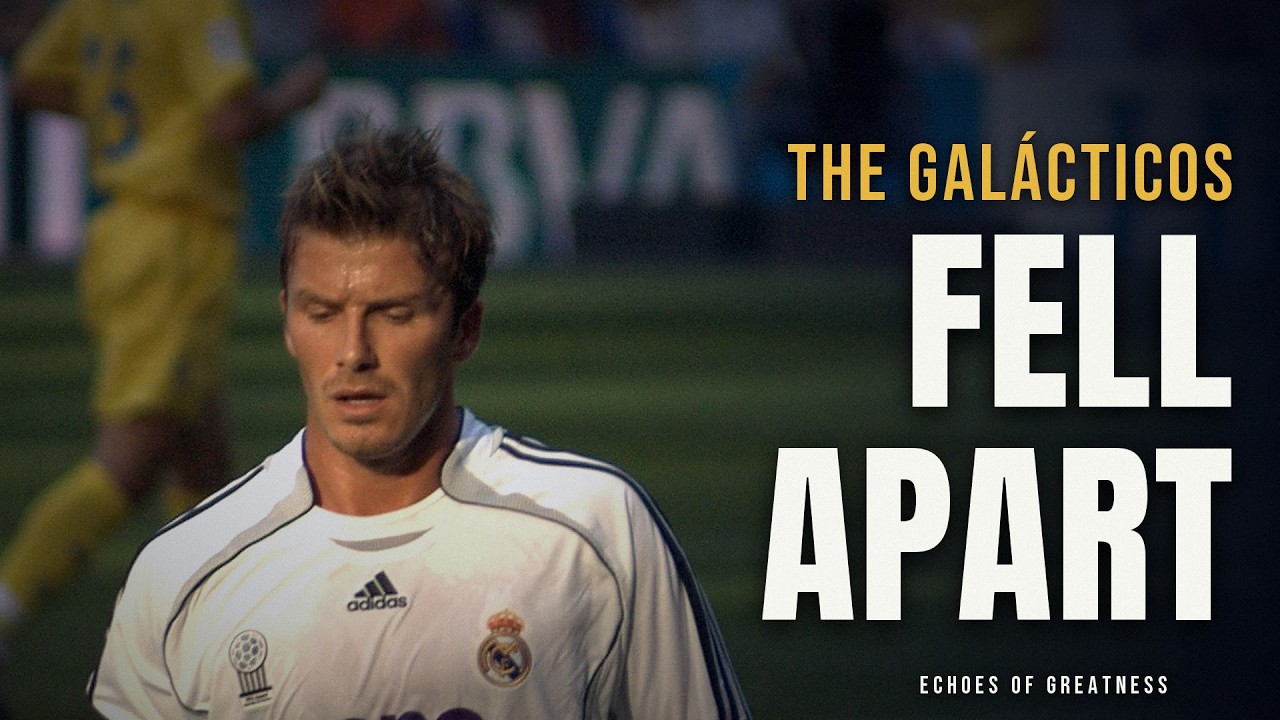
How Florentino Pérez won the presidency with a promise about Luís Figo, how the Galácticos were built and paid for, the summer Madrid let Makélélé, Morientes and Hierro go, Beckham's arrival and the tour of Asia, the 7-2 against Valladolid, Monaco, and five league defeats in a row.
In this story: 11 chapters · about 40 minutes to read
- The night the spell broke
- The transfer that made a president
- Pérez's idea of Real Madrid
- Beckham: the signing that became a global event
- The summer Madrid dismantled its own team
- Beckham arrives, and the spectacle begins
- The dream match, and the warning signs
- The winter pause, and Bayern Munich
- Madrid after 11 March
- Monaco, and the season comes apart
- The post-mortem
1The night the spell broke
For a while, Real Madrid looked as if they had found a way to make the impossible feel ordinary.
They had the world's most famous players. They had a lead in the league. They had beaten Bayern Munich and reached the Champions League quarter-finals. Their president believed the club was not simply competing with other teams. It was changing what a football club could be.
Then came Monaco.
Real Madrid had won the first leg 4-2. In the return leg, Raúl scored to put them 5-2 ahead on aggregate. Monaco pulled one back just before half-time. Then, in the second half, the team began to look empty. Monaco scored again. The tie tilted. Madrid needed a response, and there was almost nothing left to give.
The Galácticos were out.
A few weeks later, Real Madrid would lose five league matches in a row, finish fourth, and end the season without a major trophy. But the failure did not begin in Monaco. It began much earlier, with an idea about fame, money and football - and with a transfer that had already changed the relationship between Real Madrid and Barcelona.
In our Barcelona episode, we saw what Luis Figo's departure did to the club he left behind. Now we are going to look at the other side of that transfer: how Figo helped Florentino Pérez win control of Real Madrid, and how Pérez's project reached its dazzling, fragile peak in 2003/04.
2The transfer that made a president
The story begins in the summer of 2000, when Real Madrid held a presidential election. Florentino Pérez was challenging the incumbent, Lorenzo Sanz, who had just led the club to another Champions League title. Sanz had trophies behind him. Pérez needed something that would make members believe he could offer a different future.
He offered them Luis Figo.
Figo was not just an important player for Barcelona. He was their second captain, behind Pep Guardiola, one of the best footballers in the world, and one of the faces of the club. The idea that he might cross the divide and sign for Real Madrid seemed absurd. That was precisely why the promise worked. If Pérez could make it happen, he would not merely have bought a great player. He would have shown that he could take the most valuable thing in Barcelona and put it in Madrid.
There was a private agreement involving Figo's representative. The details became part of the public argument during the campaign. Pérez said Figo would come if he became president. Figo denied that a transfer was settled. Pérez then made the promise harder to dismiss: if he won and Figo did not sign, he said, he would pay every member's fees for the next season.
It was a remarkable gamble. Pérez was asking the members to vote not just for a plan, but for a transfer that many people thought could never happen. He made the promise concrete enough that backing away would be painful. The campaign became a public test of his credibility.
Pérez won.
The vote was on Sunday 16 July 2000: 16,469 for Pérez, 13,302 for Sanz. It was his second try. In 1995 he had lost the club's election by 698 votes to Ramón Mendoza. The number hides a second story. A third candidate, Gómez Pintado, took 4,154 votes, and Pérez accused him in public of being the president's submarine: a rival launched to split the opposition. When Mendoza resigned later that year, Lorenzo Sanz took over, and under Sanz Madrid won the Champions League in 1998 and again in 2000. That was the record Pérez had to beat.
The story goes that during the campaign the members were even asked a simple question: which player would you dream of having?
Now the question moved from the ballot box to Figo. Barcelona supporters felt betrayed before the transfer was even complete. Figo had to leave a club where he had been a star and arrive at its most hated rival.
The details of that secret agreement are still argued about. Figo's agent, José Veiga, signed a pre-contract with Pérez. Pérez said in 2022 that Figo himself never signed it, and called it a motivating clause. The penalty attached to it is reportedly put at 5,000 million pesetas, about 30 million euros. The agent's cut, reportedly, was a few million euros.
The news had leaked on 6 July, the day after Sanz's daughter married Madrid's right-back, Míchel Salgado. Figo denied it, again and again, in public. In one interview he said he was not so mad as to do a thing like that.
He went to Madrid.
His release clause was 10,000 million pesetas, about 60 million euros, a world record, and it was paid in late July.
That transfer gave Pérez the most spectacular opening possible. The promise of it helped him take power, and the move itself announced the kind of president he intended to be. He would use the club's global pull to bring in the most famous players in the world. He would make Real Madrid bigger than its rivals on the pitch, in the press, and in the market.
The move also gave the new rivalry a human face. Figo was no abstract symbol. He had to return to the Camp Nou in a white shirt, in front of the people who had once treated him as one of their own. That story would keep following him.
Figo was the proof that the model could work once. The next price tag would be a joke.
3Pérez's idea of Real Madrid
Florentino Pérez had grown up with the legend of Real Madrid's great European side of the 1950s, the team that won the first five European Cups. It was a constellation: extraordinary players brought together under one name, creating a spectacle that seemed larger than the sum of its parts.
That became his model.
The legend had a scale, and a stage. In May 1960, at Hampden Park in Glasgow, in front of about 127,000 people, Real Madrid beat Eintracht Frankfurt 7-3: four goals for Puskás, three for Di Stéfano. Among those watching were the players of Queen's Park, including a teenager called Alex Ferguson. In May 2002, Madrid came back to Hampden for the Champions League final, and Zidane won it on the stroke of half-time with a left-foot volley. 11 months later, Ferguson's Manchester United would be knocked out by that same club.
Pérez was also a businessman. Before taking over Real Madrid, he had built a career in politics and construction. He knew how to negotiate, how to work with powerful people, and how to make a large project look inevitable.
His own empire began with a bargain. In the early 1980s, with a group of fellow engineers, he took over a struggling builder, Construcciones Padrós, in Badalona, for the symbolic price of one peseta. A second troubled company, Ocisa, went on the same terms. He restructured them, merged them, and grew them into the group that became ACS, one of the biggest construction companies in Europe. A man who could buy a company for one peseta knew exactly what things cost, and what they could be made to earn.
When he looked at the club's finances, he saw debt and limits. When he looked at the club's name, its history and its audience, he saw an asset that was being underused.
The obstacle was that Real Madrid was member-owned. Pérez could not simply arrive as a billionaire owner and inject unlimited money. He had to find money within the club's own structure. His answer was the old Ciudad Deportiva, the club's training ground on valuable city land.
Start with the debt. By Pérez's own count, the club owed about 277 million euros. Sanz's side said it was nearer 168 million. Either way, it was a lot.
The training ground on the Castellana was zoned for sport. The city and regional governments, both run by the Popular Party, approved a re-zoning to building land, and in 2001 the site was sold for close to half a billion euros, by most accounts. In 2002, Brussels looked at the deal and found no illegal state aid. The club's own report says that its bank debt was zero on 30 June 2004, paid off by operating surpluses plus that extraordinary income. So the sale did not simply clear the debt. What it gave the club was hundreds of millions of euros of room to move.
It was a financial rescue and a football strategy in one. The transaction was celebrated by those who saw it as commercial genius. It was also challenged by critics who believed the city had granted the club an extraordinary advantage. Both reactions matter.
Then came the second half of the plan, and the club's own accounts spell it out. Ordinary income grew from 137.9 million euros in 2001 to 236 million in 2004. Marketing income multiplied by four. Staff costs, which had swallowed 90 percent of income in 2000, were budgeted at 47 percent for the next season.
That was the argument, in effect: a star pays for himself.
The most expensive players were often the most famous. The most famous players attracted attention, sponsors, television audiences and shirt sales. If a player's arrival made Real Madrid visible in markets it had barely reached before, the fee might be an investment rather than a cost.
That was the logic behind the Galácticos. Figo first. Zinedine Zidane next, in July 2001, for a world-record fee. Then Ronaldo, on 31 August 2002. Each one was already a global star. Each transfer brought a new wave of attention. The team could be presented as a living gallery: the best-known names in football, wearing the same white shirt.
Zidane has told the story of how he was recruited himself. At a UEFA dinner in Monte Carlo, Pérez passed him a napkin with one question on it: do you want to play for Real Madrid? Zidane wrote yes, in English. He told it to L'Équipe in 2022.
Jorge Valdano, the club's sporting director, gave the approach its elegant language. He could make a strategy sound like a philosophy. But Pérez was the person with the power to choose. Players were not only being recruited to improve the team. They were being selected for what they could make the club mean.
The story goes that Pérez wore the same dark suit and light-blue shirt every day and drank no alcohol. Figo is said to have joked that the real Galáctico was Florentino himself.
He was thinking on a different scale from a football club's balance sheet. In July 2003 he announced the merger of ACS, the construction group he chaired, with Dragados, which created a company with sales of about 10.8 billion euros.
He had the money and the star. Now he cleared the room. But first, in the summer of 2003, the next piece of the plan was David Beckham.
4Beckham: the signing that became a global event
On Friday 13 June 2003, Manchester United's chief executive, Peter Kenyon, met Real Madrid's José Ángel Sánchez in Sardinia. The two sides were discussing David Beckham.
John Carlin tells the story in White Angels, his book about that season. Carlin reports that United opened at 35 million euros, and that Madrid's man, Sánchez, did all he could to hide his joy.
Then, Carlin reports, Sánchez phoned Pérez. It's peanuts, he said. Pérez told him to push them down.
That was the whole difference. Manchester United were pricing a footballer. Madrid were pricing a brand.
Beckham was an outstanding passer and dead-ball specialist. He worked hard. He could strike a ball as cleanly as almost anyone. But by 2003 his public identity was much larger than his role on the pitch. He was the most famous footballer in the world, and his celebrity reached well beyond the regular audience for football.
The deal was confirmed on Tuesday 17 June: 35 million euros, about 25 million pounds. 25 million euros of it was guaranteed, seven and a half on completion and 17 and a half over four years, and up to 10 million more depended on Madrid qualifying for the Champions League and reaching the quarter-finals.
Beckham was in plaster at the time. He had broken a bone in his right hand playing for England against South Africa on 22 May, and was due to be in plaster for six to eight weeks. His Real Madrid debut would come in August, on the tour of Asia.
Barcelona had been in the picture too. On 10 June, five days before Barcelona's presidential vote, Manchester United announced that a bid from Joan Laporta would be acceptable, but only if Laporta won the election. Beckham's management company, SFX, answered that he was very disappointed and felt used as a political pawn in the Barcelona election. Laporta won the vote on 15 June, and on the 17th said that he had never promised Beckham.
The story goes that the final stages of the deal had a little theatre in them. Beckham was at a family barbecue in Sawbridgeworth when he phoned Pérez, who was at the traditional pre-match dinner before Real Madrid played Atlético Madrid. Every quiet room at the dinner had Atlético people in it, so Pérez took the call in the ladies' toilet of the directors' area at the Calderón, with Sánchez translating. It was their first conversation. Madrid won that match 4-0, on Sunday 15 June.
That night mattered for more than one phone call. Real Sociedad, from San Sebastián, led the league by a single point, and both sides played that evening. Ronaldo scored after six minutes, and Madrid were 3-0 up within half an hour. In Vigo, Sociedad were losing to Celta, and they lost 3-2. By the end of the evening, Madrid, who had started it second, were top of the table with one match to go.
The deal was finished on the 17th, with Beckham on his way to Tokyo.
The move had a sporting backstory too. After the FA Cup defeat to Arsenal on Saturday 15 February 2003, Alex Ferguson kicked a boot in the dressing room. It cut Beckham above the eye. In Ferguson's own words: "I kicked a boot. It hit him right above the eye." Whether that incident alone decided his future is too neat an explanation, but the relationship between the player and the manager had become strained.
Then, in April, came the quarter-final. Madrid won the first leg 3-1, at home, on 8 April, with goals from Figo and two from Raúl. At Old Trafford they lost 4-3, and went through 6-5 on aggregate. Ronaldo scored a hat-trick and was given a standing ovation by the Old Trafford crowd. Beckham, dropped to the bench, came on and scored twice. Neville is quoted as saying it was like facing the Harlem Globetrotters. Beckham says that at the shirt swap, Zidane asked him: are you coming to Madrid? He told that in his Netflix series in 2023.
Among the crowd at Old Trafford that night was a Russian businessman who, it was said, had never cared much for football: Roman Abramovich. The story goes that he watched Ronaldo's hat-trick, called it a truly beautiful game, and decided he wanted a club of his own. Within weeks he owned Chelsea. Within a few more, Chelsea had signed two of Madrid's players, Geremi and Makélélé, and on 1 September, with Abramovich's money, the Makélélé deal was done. The show Pérez was building had helped create the one buyer rich enough to take the one man the show could not use.
The story goes that the Madrid dressing room had cheered when the quarter-final draw was made, certain they could not lose. Then came the semi-final, and Juventus: 4-3 on aggregate.
The transfer also made sense in Pérez's system. David Beckham could help the club sell its project in parts of the world where the Real Madrid name was still growing. He had an enormous following in Asia. A Real Madrid tour built around him could turn pre-season into a commercial event on a scale football had rarely seen.
That summer, the club would demonstrate exactly how powerful that attention could be. The question was whether the team would be as well prepared for the football season as it was for the cameras.
5The summer Madrid dismantled its own team
Real Madrid had just won the league. David Beckham was arriving. From the outside, it looked like the club was adding another star to a winning team.
Inside the squad, something else was happening.
Madrid had clinched the title on Sunday 22 June 2003, beating Athletic Bilbao 3-1, with two goals from Ronaldo and one from Roberto Carlos. They finished on 78 points, two ahead of Real Sociedad.
Beckham missed it. He and Victoria had landed in Bangkok that same day, to a quiet welcome of about 20 fans, and been driven to a health resort at Hua Hin. The story goes that, jet-lagged and awake, he switched the television on low so as not to wake Victoria, and watched Madrid win the league. He had agreed his move. He was not yet a Madrid player.
On Monday the 23rd, a board meeting ended the time of Vicente del Bosque and Fernando Hierro. Jorge Valdano announced it. Del Bosque said he was told in a corridor at about 11 at night: the loneliness of the corridor, he called it. He had given 35 years to the club. Hierro had spent 14 seasons there, played about 600 games, scored 127 goals and won 16 titles.
Madrid explained it as the end of a cycle. That was Valdano's phrase. Pérez spoke of signs of exhaustion in Del Bosque, and said Hierro had completed his cycle. Hierro was 35.
Carlos Queiroz was named on Wednesday 25 June, eight days after Beckham. He was Portuguese, and had been Alex Ferguson's assistant at Manchester United. He knew Figo well. I coached him from 13 to 22, he told UEFA the next day, and making him a better player would be a challenge. Queiroz had led Portugal's under-20 side to the world youth title in 1989 and again in 1991, the year Figo won it.
According to ESPN's Galácticos series, made in 2021, the title night ended with a dinner at about half past four in the morning. Hierro led the dissent. Valdano sat in the middle. Pérez told them off.
The story goes that at the last home game a banner read: you cannot buy and sell Real Madrid; Guti is one of us, and that it was the fans' fear that their own idol would be pushed aside for Beckham. Whatever the banner said, a news agency reported the crowd begging the president not to let Guti go. And the story goes that a wall near the Bernabéu carried the words: Florentino, traitor.
The story goes, too, that Queiroz signed his contract at Figo's house, and that Pérez's brief for a coach was maximum freedom, minimum orders.
Fernando Morientes, a proven centre-forward and an important alternative to Ronaldo, was sent on loan to Monaco. Claude Makélélé, the defensive midfielder who covered space, won the ball and allowed the attacking stars to take risks, was sold to Chelsea.
Makélélé went in the early hours of 1 September. The Guardian put the fee at 16.6 million pounds. He was 30, and the pay dispute went back to August. Pérez's case against him was printed in France Football and repeated in the Guardian on 11 September: he rarely passed the ball more than three metres, younger players would make people forget him, and Beckham had compensated totally. Pérez added that he had offered Makélélé a raise, but the player wanted about half of Zidane's pay, which was impossible. A ball-winner who hardly ever scored: that was the case against him.
Makélélé told it differently, 18 months later, to the journalist Amy Lawrence. It had nothing to do with anyone else's pay, he said. He had taken the president's word. They had shaken hands, and he believed everything was arranged. That, he said, was his stupid mistake. What he had wanted was respect. Queiroz said years later that the club's side of it was simpler: Makélélé left because he did not sell enough shirts.
Years later still, when Zidane was Madrid's manager, he found his own Makélélé in Casemiro, a ball-winner in front of the defence, though not until a couple of months into the job.
Gabriel Milito, a centre-back who played for Independiente, was close to joining. Madrid agreed a four-year deal with him on 8 July, then cancelled it on the 22nd, after the club's doctors judged an old right-knee injury a risk. Queiroz says Milito had passed the medical and signed. Zaragoza signed him about two days later.
In hindsight, the summer can be reduced to three missing Ms, the label Queiroz gave it later: Makélélé, Morientes and Milito. One could protect the midfield. One could give the attack a different shape and a reliable alternative. One could fill a hole in central defence. By 1 September, all three were gone, or had never arrived, and Madrid played the rest of the season without them. Queiroz would later describe the team, in a radio interview in 2016, as a Ferrari without a wheel.
The departures were not all of equal importance. Some players were past their best or did not fit Pérez's vision. Others were useful professionals who made the squad function. Steve McManaman left. Flávio Conceição and Albert Celades went out on loan. Geremi and Iván Campo, already on loan in England, were sold. About ten players left in all. The club was not simply clearing out dead weight. It was removing depth.
The way Morientes learned he was leaving captured how little control the new coach had over the squad. Queiroz says he heard it from the player himself. At the end of that opening week, as he tells it, he told Morientes he would see him on Tuesday. Morientes asked whether he did not know he had been loaned to Monaco. The loan was agreed on the 30th and 31 August. Morientes had come on in the league opener against Betis, for Zidane, in the 86th minute.
The policy became known as Zidanes y Pavones: world-famous signings at the top, young players from the academy beneath them. Valdano had used the phrase in January 2003. There was a sensible principle in giving homegrown players a path into the first team. The problem was the gap between the two levels: stars on top, cheap academy kids underneath, and nothing in between.
Queiroz inherited a team with immense attacking quality and obvious structural gaps. Iker Casillas, 22, was a world-class goalkeeper. Roberto Carlos and Míchel Salgado were formidable full-backs. Iván Helguera could play in midfield but was used in central defence, next to young partners. The young defenders available, Pavón, Rubén, Mejía and Raúl Bravo, had little experience at this level.
In midfield, Beckham was asked to play centrally, like a quarterback, because Figo occupied the right side. Beckham had the passing range for the role, but the partner beside him mattered. Guti could create, but he was not a natural defensive shield. Esteban Cambiasso could have helped provide balance, yet he made only nine league starts. The team had more than enough imagination. It did not have enough protection.
Ahead of them were Figo, Zidane, Raúl and Ronaldo. That was an extraordinary attacking group. But if Ronaldo was injured or exhausted, the options were thin. Javier Portillo was young and promising, but he was the only striker cover. Santiago Solari was the nearest thing the squad had to a middle class.
The story goes that every Galáctico was paid the same, five and a half million euros a year. Whatever the truth, the picture was the same: the stars at the top, and the middle priced as an afterthought.
The squad was built around an assumption: if the stars were fit and in form, they would win. The assumption concealed a second one: that the stars could play nearly every important match, because the club had not kept enough alternatives.
A team can look unbeatable when its best 11 are fresh. A season tests what happens when they are not.
6Beckham arrives, and the spectacle begins
David Beckham's first days in Madrid were not an ordinary signing announcement. The transfer was a rolling global event. His own trip had started earlier, in Asia: Tokyo on Friday 20 June, where he showed his skills to about 350 pupils at a school near Ginza, with thousands outside and helicopters overhead. Then Bangkok, from the 22nd. Then Ho Chi Minh City on the 25th, where reports spoke of thousands.
He landed at Torrejón on Tuesday 1 July, had his medical that afternoon, and was presented on Wednesday 2 July in the basketball arena, to more than 500 journalists from 25 countries. Alfredo Di Stéfano handed him the number 23 shirt. It took two days, not a few hours, but it felt like one long event.
Then the squad went on tour. A training camp in Kunming from Friday 25 July. The cigarette maker Hongta put up about a million dollars for the China leg. Then Beijing on 2 August, a 4-0 win in front of a reported 50,000, with goals from Figo, Morientes twice and Portillo. It was Beckham's first game in a Madrid shirt. Tokyo on the fifth, 3-0, and Beckham's first goal for the club, a free kick from about 25 metres. Hong Kong on the eighth, 4-2. Bangkok on the tenth, 2-1. 25 players, about 18 days.
The Associated Press described folk dancers with elephants and about 400 fans in matching white shirts at the arrival. The Globe and Mail described the team bus covered in graffiti, with I love Beckham among it. ABC reported that the squad walked out of a Chinese dinner after 20 minutes, and that a Hong Kong training event for fans was cancelled for tiredness. Then came a public apology after players were seen in nightclubs.
In Kunming, the squad trained on a neighbouring pitch, out of sight, because the planned one was soaked. Hundreds of ticket-holders went home with nothing to watch, and a Beijing reporter said the Chinese media were dissatisfied, because there was so little to write about. A reporter at the camp says the greeting parties were cigarette-factory workers, brought in by lorry, their shift switched from rolling cigarettes to welcoming Real Madrid.
A reporter who followed the squad told what happened at the camp. After the second day's training, he says, Roberto Carlos was locked out of the team bus by the driver. He hammered on the window. Zidane waited on the step. And Santiago Solari started playing bongos on Zidane's back.
It was a ridiculous moment. It was also a useful one. Once the cameras, sponsors and security were stripped away, the Galácticos were still a group of footballers teasing one another on a team bus.
At a press conference, the same reporter says, a Chinese journalist asked Roberto Carlos why Ronaldo was so fat and he was not. Roberto Carlos laughed and replied: Ronaldo is not fat, Ronaldo is strong. Another journalist asked Queiroz whether playing for Madrid risked the life of a panda behind glass in a reserve. And on a heart-rate run, 23 players jogged along in a bunch, and Ronaldo's pulse raced after a single lap, so he sat down, laughing.
Beckham is said to have told his own story of that trip later. He had packed three huge suitcases. The other players arrived with tiny bags. So he repacked in the car park, down to two pairs of boots and a tracksuit. Then he found out that the others had simply left their luggage at the entrance for the staff to check in. He spent days in borrowed clothes and flip-flops. And Figo, in good English, wrote his phone number on a scrap of paper: ring me for anything. As the camp began, Raúl described the new arrival in a few words: a little timid, because he did not speak Spanish, though Míchel Salgado, Solari and Figo had helped him a lot.
The story goes that Spain's ambassador to the United Nations told a university audience that Beckham was finishing what Philip the Second had failed at, the empire where the sun never sets. And this time, he said, a Briton would help.
The tour made Madrid famous in new places. It also took energy from a team that had not yet solved the problem of how all its stars would fit together. Both things were true. And when the season began, the football briefly made Pérez's vision look perfect.
7The dream match, and the warning signs
The season began with a trophy. In the first leg of the Spanish Super Cup, on 24 August, Madrid lost 2-1 away to Mallorca. It was Beckham's first competitive match in a white shirt, and it went badly. Figo scored in the 18th minute, Bruggink equalised just before half-time, and two minutes after the restart a young Cameroonian striker called Samuel Eto'o put Mallorca ahead. Eto'o had come to Real Madrid at 16, been sent out on loan, and still belonged half to the club. Around the 54th minute, Queiroz took off his new star and sent on Claude Makélélé. One match report says the cameras caught Beckham kicking a plastic bottle in disgust. Eight days later, Makélélé was sold.
In the return, on the 27th, Raúl scored just before half-time, Ronaldo scored after the break, and in the 73rd minute Beckham headed in a cross from Ronaldo, his first competitive goal for the club. 3-0, and the cup, 4-2 on aggregate.
Three days later, in the league opener against Real Betis, on Saturday 30 August, Beckham scored in the first minutes, and Madrid won 2-1. The sceptics in Spain had been ready to ask whether Madrid had signed a footballer or a celebrity. Two goals in his first two home games gave the first answer.
On 2 September, Madrid drew 1-1 at Villarreal, Antonio Núñez equalising in the 85th minute. Then came Valladolid at the Bernabéu, on Saturday 13 September.
This was the night when the stars appeared to answer every question at once. Figo, Zidane, Ronaldo and Raúl all scored, and for most of the match the team looked less like a collection of famous names and more like a functioning side.
They scored seven and won 7-2. Raúl scored a hat-trick. Zidane scored, Figo scored a penalty, Ronaldo scored, and there was an own goal. Valladolid would finish the season 18th and go down. The story goes that Madrid should have conceded a third, which would have made it 7-3, the score of the 1960 European Cup final.
One goal was a perfect image of the Galáctico promise: the fourth. Beckham sent a long diagonal ball from the right. Zidane met it with a left-foot volley and drove it into the goal.
The story goes that Beckham called it the best pass he ever hit. And that Valdano put it like this: you could read the maker's name on the ball, classified information that only a Zidane could decode.
Raúl's goals, the second and the third of the match, came within three minutes of each other: a back-heel from a Figo cross, and a lob. The debate over which goal was best could have lasted all night. The more important point was that the players were making one another better. The stars were not obstructing each other. They were connecting.
For Pérez, this was the image he had been selling. The best-known players in football, sharing a stage and producing something that no ordinary team could reproduce.
But the season was not all Valladolid.
Madrid beat Málaga 3-1 on 21 September, with goals from Ronaldo, Beckham and Guti. Then, on the 27th, Valencia beat them 2-0, Mista scoring in the opening minutes. It was Madrid's first league defeat of the season, dangerous but not alarming.
The more telling result came on Sunday 9 November, in Seville. Sevilla won 4-1. Helguera put the first one into his own net by the sixth minute. Darío Silva, Daniel Alves and Casquero scored, and within 38 minutes Madrid were 4-0 down. Ronaldo got a consolation goal after the break.
Salgado and Roberto Carlos were both out, so Queiroz played Pavón, Raúl Bravo and the 21-year-old Rubén across the back, beside Helguera. Before the half-hour, with Madrid already 3-0 down, Queiroz took Rubén off, and the boy went to the bench in tears. Years later Rubén said they were a kid's tears, from seeing his dream slip away, that Queiroz never spoke to him again, and that he held no grudge. By the end of the season he was on loan in Germany. It would have been easy to call the whole afternoon a freak accident.
That was not just one bad afternoon. It was a view through the cracks. A normal team would never allow that, because a normal team has someone underneath.
Europe was kinder. In the Champions League they had opened with a 4-2 win over Marseille on 16 September, with Roberto Carlos, two from Ronaldo and a Figo penalty, against goals from a young Didier Drogba and Van Buyten. They won 3-1 at Porto on 1 October and drew 0-0 in Belgrade.
Then, on 26 November, they went back to Marseille, and the city was waiting for its son. A mural of Zidane, 150 square metres, looked over the coast with the words Made in Marseille. He had left the city at 14 without ever playing for the club he supported, and said he expected goose bumps in the tunnel. He had played at that stadium before, for Bordeaux and for France, but never in white. Madrid won 2-1, with a Beckham free kick and a goal from Ronaldo, and took the group with 14 points.
In the league, Beckham was playing in holding midfield now, and the experiment of putting him out on the right, against Osasuna, had failed. Spain had thought he was the haircut, the poster and the free kicks. By December it was asking different questions. On 3 December, Madrid beat Atlético 2-0 at the Bernabéu, Ronaldo scoring in the first minute and Raúl in the 20th, and went clear at the top, with 30 points.
Then there was the Camp Nou. Madrid's players went to the Camp Nou again and again in the Figo years, and three of those visits made a story of their own.
The first was in October 2000, Figo's first return. Barcelona won 2-0. Before the match, the Madrid bus was pelted with bottles and stones, and in Pavón's account, told to Sky, the players sheltered in the middle of the bus.
The second was in November 2002, the night of the pig's head. Objects rained down. The match was stopped for more than ten minutes, 12 to 15 depending on the source. Figo kept trying to take corners. Salgado, who used to offer him a short corner, says that by the second or third one he told Figo he was on his own, and that he saw a knife thrown, though that was never confirmed. It finished 0-0. The Spanish federation closed the Camp Nou for two matches and fined Barcelona 4,000 euros. The club appealed for more than two years, and in the end, reportedly, only the fine was left. 4,000 euros, against the 60 million Madrid had paid for the man the head was meant for.
The third was on Saturday 6 December 2003. Madrid won there, in the league, for the first time in about 20 years: Barcelona one, Madrid two. Roberto Carlos scored with a deflected shot in the 37th minute, Ronaldo scored, and Kluivert pulled one back late. Figo started. The story goes that the players had agreed beforehand that he should not take the corners, and that the bus ride had its ritual, the curtains drawn, everyone down on the floor with their arms over their heads, through the tunnel, and then somebody said: all clear.
Roberto Carlos was the decisive man in that match. Spain called him el Hombre Bala, the Bullet Man. He was one metre 68 tall, and the Guardian once put his thighs at 24 inches. The story goes that he had a sprinter's burst and a long-distance runner's lungs.
December was the peak. At the FIFA World Player gala in Basel, on the 15th, Zidane finished first, his third award after 1998 and 2000. Ronaldo was third. Roberto Carlos was fifth.
Then came the twist. The Ballon d'Or, announced on the 22nd and voted by journalists, went to Pavel Nedvěd, with 190 points. Henry had 128, Maldini 123, Shevchenko 67. Zidane was fifth with 64. Raúl was seventh, Roberto Carlos eighth. Figo got no votes at all. And a raw 22-year-old, Zlatan Ibrahimović, was joint 20th, with two points.
Through star-glasses, everyone in Madrid was the best. Looked at on the pitch, it was less clear.
At the winter break, after 17 rounds, Madrid led the league with 39 points, two ahead of Valencia and six ahead of Deportivo. Barcelona were ninth, with 24 points, 15 behind. But a successful first half did not solve the team's central problem. It only postponed the test.
8The winter pause, and Bayern Munich
When the players returned, the transfer window offered Madrid a chance to correct the squad.
As far as we can tell, Madrid added nobody in January. Queiroz said years later that it was a miracle they were eight points clear with the squad they had. The iceberg was in plain sight.
The results held up. On 10 January, a 1-0 defeat at Real Sociedad ended a seven-match unbeaten league run and put Valencia top. Two weeks later, Madrid beat Villarreal 2-1, with goals from Solari and Ronaldo, and went back to the top, 46 points to 44. In the Copa del Rey they went through against Eibar, then beat Valencia in the quarter-final, 3-0 at home and 2-1 away, with Zidane scoring the winner in injury time. In the semi-final they beat Sevilla 2-0 at home and lost the return 1-0. Zaragoza, meanwhile, had knocked Barcelona out in the quarter-final, with a penalty from a young striker called David Villa.
On 14 February, the newspaper AS ran a piece headlined Madrid chase the clover: the league, the European Cup and the Copa del Rey, all in one season. The next day Valencia came to the Bernabéu and drew 1-1, Ayala putting them ahead and Figo equalising with a penalty in stoppage time. By 24 February, Madrid were five points clear in the league.
John Carlin tells a story from the dinner before the first leg against Bayern Munich. Pérez and Sánchez, half joking, imagined auctioning the 11th place on the team to an amateur who would pay 30 or 35 million, play for a quarter of an hour, and be substituted. Six auctions a match. Then, if the whole world supported Madrid in a generation, who would they play? Then it is performance art, they joked: take away the goalposts. Pérez had one warning. Even if Bayern are weak, he said, they are Germans.
It was a joke about a team imagined entirely as a show.
The first leg was in Munich, on Tuesday 24 February. Bayern dominated. Roy Makaay headed in a cross from Pizarro in the 75th minute. Roberto Carlos clashed with Demichelis and was banned for two matches, upheld on 8 March. So he would miss the return, and the next European match too. Who is underneath?
In the 83rd minute Roberto Carlos's free kick, from about 30 metres, went under Kahn. UEFA says it took a deflection; the German accounts we found mention none. Kahn said he would now have to win the return alone. It finished 1-1.
That was the pattern: Madrid could be outplayed and still escape with a result because one of their stars produced a moment, or because an opponent made a mistake. The escape preserved the illusion that everything was fine.
Five days after Munich, on Sunday 29 February, a 4-2 win over Celta put Madrid on 59 points: eight clear of Valencia, nine clear of Deportivo and 13 clear of Barcelona. It was the biggest lead of their season. It would last one weekend. On 6 March they could only draw 1-1 at Racing Santander, while Valencia won. The lead was six.
Four days later, on Wednesday 10 March, Madrid won the Bayern return 1-0 at the Bernabéu. Zidane scored in the 32nd minute, and Salgado won the header. It was a warriors' win rather than a stars' win. They were through to the last eight, and six points clear in the league.
It was the last night with no reservations.
The next morning, at about half past seven, there were trains in Madrid.
9Madrid after 11 March
On the morning of 11 March 2004, bombs exploded on commuter trains in Madrid. Ten bombs on four trains, at Atocha, at Calle Téllez, at El Pozo and at Santa Eugenia. 191 people were killed, and more than 1,800 were injured. It was the worst terrorist attack in the history of Spain.
The government first blamed the Basque separatist group ETA. Three days later, on Sunday 14 March, it lost the general election.
This was a national tragedy, far larger than football. Real Madrid's next match was on Saturday 13 March, the day before the vote. It was played with a minute's silence, and it finished 1-1 against Zaragoza. Madrid had been six points clear before it. By Sunday night, they were four.
The attacks changed the mood of the whole country. But football's problems were already visible. The slide had begun on 6 March, five days before the bombings. The context matters. So does the football. We should not use one to erase the other.
Four days after the Zaragoza draw, on Wednesday 17 March, Madrid and Zaragoza met again, in the Copa del Rey final. It was played on neutral ground at Montjuïc in Barcelona, in front of about 54,000 people, six days after the bombings.
Beckham's free kick put Madrid ahead. Then Dani, and a penalty from Villa, turned it round before half-time. Roberto Carlos levelled with a free kick at the start of the second half. Zaragoza's Cani was sent off, but Madrid could not use the extra man. In extra time Guti was sent off too. Near the end, Galletti scored the winner. Zaragoza won 3-2.
It was a damaging defeat. The irony was that the men who beat them included Gabriel Milito, the defender Madrid had tried to sign, and a young David Villa.
Was that the moment the season turned? Many commentators called it the catalyst to the slide. Queiroz said years later that the decline did not start with the final. We can hold both.
AS and Beckham had both spoken of the clover: the league, the European Cup and the Copa. The first leaf was gone. And the lead in the league, which was eight on 29 February, had been six after Racing and four after Zaragoza. After Bilbao, it would be one.
Three days later, Bilbao.
10Monaco, and the season comes apart
On Saturday 20 March, Madrid lost 4-2 at Bilbao. Yeste and Urzaiz put Athletic 2-0 up before half-time. Raúl scored twice after the break to level it at 2-2. Then Del Horno scored twice in two minutes, and the lead in the league was now one point.
Four days later, on Wednesday 24 March, Monaco came to the Bernabéu. On paper, the quarter-final looked comfortable. Madrid were the glamour club. Monaco were a smaller side with less star power. Madrid were also still leading the league, by a single point.
Monaco had a Real Madrid striker on loan, Fernando Morientes, leading their attack. He was now in a position to punish the club that had loaned him out.
Before the match, Queiroz said it had been a black week, but that the club had not lost its strength. His defence was stretched: Raúl Bravo went off injured after 28 minutes, and Pavón came on.
Squillaci's goal put Monaco ahead, and it was 0-1 at half-time. Then Madrid scored four goals in half an hour. Helguera. Zidane. Figo, from the rebound of his own penalty. And Ronaldo, who had missed about two weeks with a hamstring tear and had come back for this match. Morientes headed in on the 83rd minute to make it 4-2. The story goes that he did not celebrate, out of respect for a crowd that had once been his, and that part of the stadium applauded him. Beckham was booked in stoppage time, and so was suspended for the return.
Four days later, at the Bernabéu, Madrid beat Sevilla 5-1, Ronaldo scoring twice. It was the false dawn.
The return was on Tuesday 6 April. Raúl made it 5-2 on aggregate in the 36th minute. For a moment, Madrid seemed to have the tie under control. Monaco needed goals.
Madrid's grip did not survive the half-time whistle. Giuly scored just before it. Then Morientes, in the 48th minute, with a header from a cross by Evra. Then Giuly again, a little after the hour: a low cross from Ibarra, met with a back-heel through Roberto Carlos's legs and past Casillas. In football, that goal has a name, a Madjer, after the Algerian who scored the same way for Porto against Bayern Munich in the 1987 European Cup final. Porto were the team Monaco would meet in their own final. Within about 20 minutes, it had come apart. Monaco won 3-1, and went through on away goals, 5-5.
Morientes, the striker Madrid had loaned out, had scored in both legs, and would finish as the Champions League's top scorer, with nine. My heart is in Real Madrid, he said afterwards, but I also have a part of it in Monaco now. I suffered a lot at Real last year.
Beckham, suspended, was on a ski holiday in the Alps with his family, the story goes.
Giuly has told a story about that night. At half-time, he says, Zidane told him that Madrid were finished. Years later, in January 2026, Giuly said on French television that he had exaggerated: Zidane had only said they were not playing well. A story inside a story. Both versions are his.
Straight after the match, Zidane said Monaco had deserved it and had been far better. Queiroz called it a very painful result, and said Madrid had to accept it. Monaco went on to the final, beating Chelsea 5-3 on aggregate in the semi-final, and lost it 3-0 to Porto, coached by José Mourinho, on 26 May.
The league was slipping too. On Sunday 11 April, Madrid lost 0-3 at home to Osasuna, their first home league defeat of the season. They had been unbeaten in their first 15 league games at the Bernabéu. They would lose the last four. Valdo, who had come through Madrid's reserve team and been let go, scored in the first minutes, Pablo García added a second before half-time and Moha a third. Ronaldo started, but was substituted after about 26 minutes. The same day, Valencia won at Zaragoza and went top. Madrid were two points behind. Six days later, on the 17th, Madrid won at Atlético Madrid, and led the league again, 70 points to 69, for exactly one day.
The same period brought tabloid attention to Beckham's private life. On 4 April, the News of the World published allegations about Beckham and Rebecca Loos, his former assistant. Beckham called the stories ludicrous, said he was happily married, and did not sue. Reports said his wife and sons mostly stayed in England. It is impossible to know whether any of this affected his football.
Madrid were also an ageing side in key positions. Figo and Zidane were 31. Roberto Carlos turned 31 on 10 April. Beckham was 28, and turned 29 on 2 May. Ronaldo was 27, and he was not injured all the time: he played 32 league games and scored 24, the league's top scorer.
Then Barcelona came to the Bernabéu, on Sunday 25 April.
In our previous episode, that match was the turning point in Barcelona's story: Ronaldinho created the winner for Xavi, and the new Barcelona began to believe it could overtake Madrid. Solari scored in the 54th minute, Kluivert equalised four minutes later, and Xavi won it in the 86th. Ronaldo was not in the squad. Figo was sent off. A few months earlier, Barcelona had been about 18 points adrift. Barcelona went above Madrid only on 16 May, not at this match, but the tide had turned.
Then came the last run. On 1 May, Deportivo won 2-0; Zidane was sent off. On the eighth, Madrid lost 3-2 at home to Mallorca. Samuel Eto'o scored twice, and, reports say, ran towards the president's box and wagged a finger at Pérez. The boy Madrid had sent out on loan, and still half owned, was presented as a Barcelona player on 12 August. On Sunday 9 May, Valencia clinched the title by winning at Sevilla. On the 16th, Madrid lost 2-1 at Murcia, the bottom club in the division, and Beckham was sent off, reportedly for insulting an official. And on the 23rd, Real Sociedad won 4-1 at the Bernabéu.
Zidane, Guti, Salgado and Beckham were all suspended for that last match. The thread, in one fact. Five league defeats in a row, a club record.
Valencia finished with 77 points. Barcelona were second on 72, Deportivo third on 71, and Madrid fourth on 70: 70 before the last five games, and 70 after them. They had scored more league goals than anyone, 72, and conceded 54.
The final five defeats had several causes, and the people involved named different ones. The stars who had generated so much excitement were being asked to solve problems the club had chosen not to address.
The Monaco defeat had exposed the failure. The league run made it impossible to deny.
11The post-mortem
The next day, 24 May, Pérez stood in front of the press. If you ask me whether we made a mistake contracting Queiroz, he said, I have to admit we made a mistake. The reason he gave: a coach needs authority. Queiroz was gone. Camacho was in, and Walter Samuel was announced the same day.
Queiroz's record as Madrid's coach was 59 matches in all competitions: 34 wins, 11 draws and 14 defeats, with 113 goals for and 76 against.
Everyone who had been there picked a different culprit. Years later, Queiroz said it was the squad built that summer, a Ferrari without a wheel. Keeping Morientes would have been enough, he said, without selling Makélélé on the cheap. The president did not want to understand things, and in the end I paid for it. Commentators said it was the Copa final. Guti, in an interview published on 19 May, said: we are very tired, because we do not have enough players. Pérez said: not enough authority. And Figo said Queiroz had done everything possible.
So go back to the question we started with. Makélélé left on 1 September. On 29 February, six months later, Madrid were eight points clear. So selling him alone did not sink them.
The falls came one by one. Roberto Carlos's ban. Beckham's ban. Ronaldo's hamstring. The red cards. The 31-year-old legs. And four starters suspended for the last match. From 29 February, Madrid took 11 points from 36. Valencia took 26.
The irony is that the champions were built partly from Madrid-trained men. Their coach, Rafa Benítez, had coached Madrid's reserve and youth teams between 1986 and 1993. Their top scorer, Mista, had come through Madrid's system and never played for the first team. Valencia won the league on 77 points.
Jorge Valdano resigned a few days later. It was Valdano who had given a 17-year-old Raúl his first-team debut, and Raúl's first son, born in 2000, is reportedly named Jorge after him. Years afterwards, Valdano told Sid Lowe, in a piece in The Blizzard in 2013: football cornered us and stabbed us for it.
The story goes that he reached for images to explain it. He compared the team to a circus. Madrid had hired the most spectacular trapeze artists they could find, then asked them to perform without a safety net. In the end, they would not do it any more. And the club, the story goes, was a mosaic whose pieces had not been held together by enough cement.
Pérez was not wrong about the commercial power of star players. Beckham's arrival made Real Madrid a global story. The club understood how to turn its history, famous names and performances into attention on a scale other teams could not match. Pérez helped build the modern commercial giant that Real Madrid became.
But the 2003/04 season showed the limit of that idea. A football team is not a collection of individual brands. It needs depth. It needs players who make difficult work look ordinary. It needs people who protect the stars and make it possible for them to decide matches.
Makélélé did not sell the most shirts. He made the team function. Morientes was not the most famous striker in the squad. He gave Madrid another way to attack. A dependable centre-back would not have drawn the same headlines as Beckham, but Madrid needed one. Those players were not decorations around the Galácticos. They were part of the foundation.
And what happened next? Pérez himself was re-elected on 11 July, with about 94 percent of the votes. Because they had finished only fourth, Madrid had to play a Champions League qualifying round that August, and beat Wisła Kraków 5-1 on aggregate. They signed Michael Owen, for about 12 million euros, and Jonathan Woodgate. Patrick Vieira, who had been linked with Madrid all summer, stayed at Arsenal. Camacho resigned on 20 September 2004, after six games, a 3-0 defeat at Leverkusen and a 1-0 defeat at Espanyol. After Queiroz, Madrid used four coaches in two seasons: Camacho for six games, García Remón for 20, Luxemburgo for 45 and López Caro for 24. In the next season they finished second, four points behind Barcelona, and went out of the Champions League to Juventus in the last 16. Figo left for Inter in the summer of 2005. And Pérez resigned on 27 February 2006: my departure, he said, is a way of reminding them that the only important thing is Real Madrid.
There was no trophy after the August 2003 Supercopa until he left. The next league title came after he had gone, in 2007. He came back in 2009, and bought Cristiano Ronaldo and Kaká, for reported fees of about 94 and 65 to 67 million euros.
The first Galáctico project did not collapse because it lacked talent. It collapsed because talent was asked to do every job. The club had brought the brightest players together, but it had not built a team capable of carrying them through a season.
A safety net earns nothing. That season, nobody paid for one.
Enjoyed the story? The film has the pictures, the music and the goals.
Watch Episode 2 on YouTube